
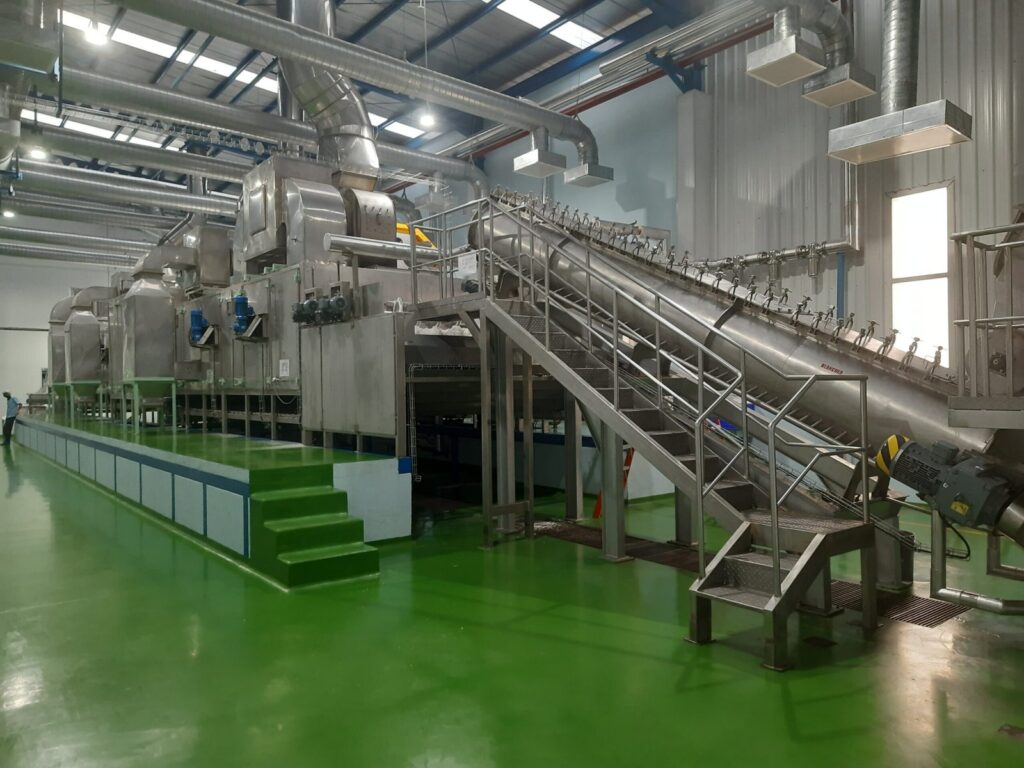
How do you protect a belt dryer plant against fire? Most belt and band dryer fires start in deposits, not in the product bed. Fines, fat and sugar-rich particles collect under the belt, on heater coils and in recirculation ducts, dry out completely, self-heat and smoulder until fresh air or a hot surface turns them into flame. Protection therefore has four layers: a design that leaves few places for deposits, temperature limits based on tested ignition data, detection that catches smouldering early, and zoned suppression with clear shutdown logic. This guide is for project engineers, plant managers and investors specifying a belt, band or mesh belt dryer line as part of an EPC (engineering, procurement and construction) project.
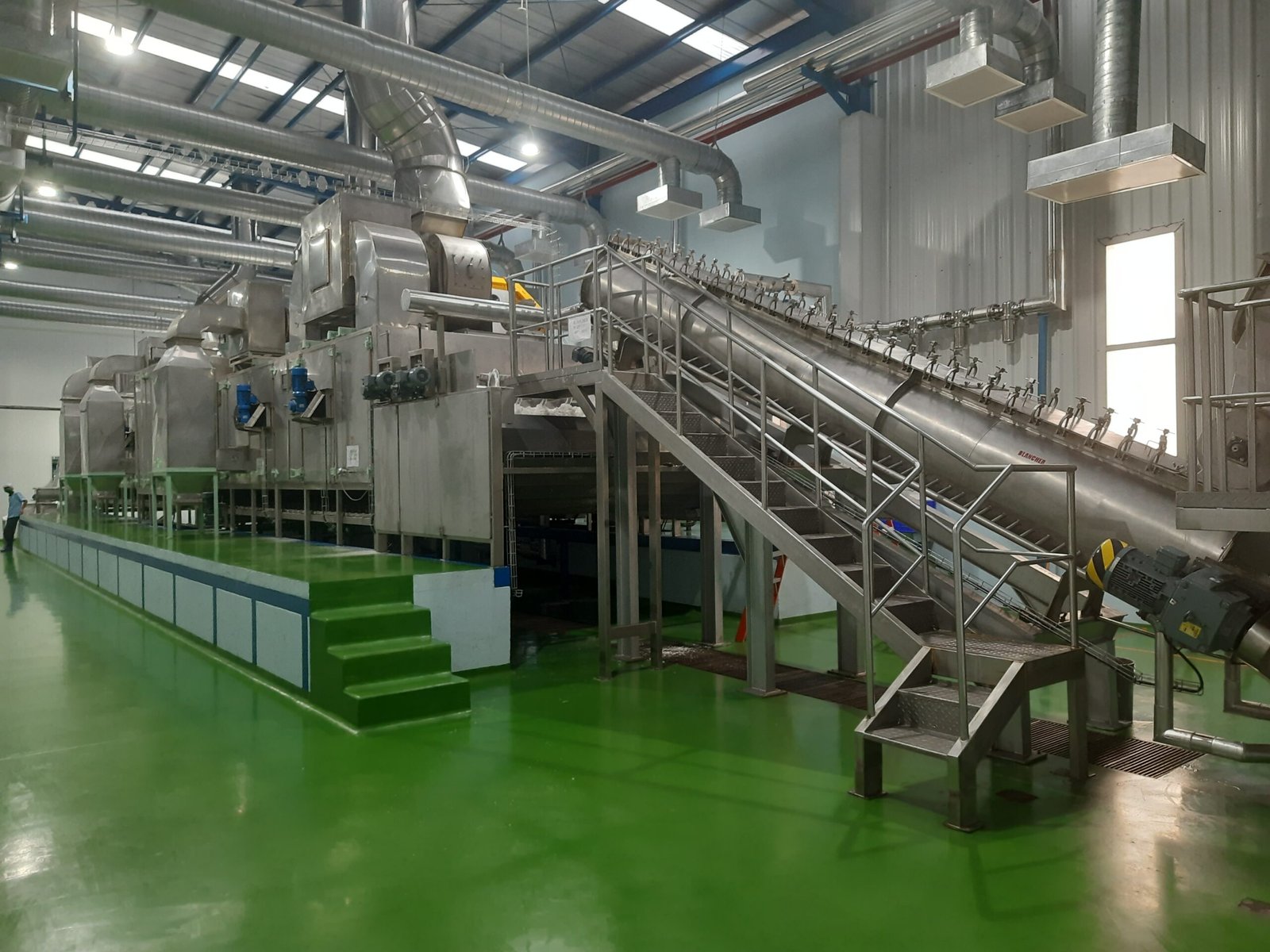
Why is belt dryer fire protection being reviewed now?
Because the main US reference standard has changed. NFPA 660, Standard for Combustible Dusts and Particulate Solids (2025 edition), was issued on 16 November 2024 and became effective on 6 December 2024. It consolidates NFPA 61 (agricultural and food processing), NFPA 652, NFPA 654 and three other dust standards into one document.
The 2025 edition adds requirements to evaluate self-heating and thermal instability, defines an operational readiness review, and states who may perform a dust hazard analysis (DHA) (NFPA 660 development page, accessed November 2026). Self-heating is how many deposit fires begin. Outside the US, local fire authorities and insurers set the requirements, though NFPA documents are widely used as references. Nothing here implies that any dryer complies with a particular code.
Where do fires start in a belt or band dryer?
In places where product fines stay longer and get hotter than the product on the belt. The usual locations are the floor or trays under the belt, heater coil fins, fan housings and return-air ducts, burner or furnace connections on direct-fired zones, and the cooling section, where a smouldering particle can be carried towards milling, packing or storage.
| Location | How the fire starts | Design response |
|---|---|---|
| Floor or trays under the belt | Fines fall through the mesh, dry to near 0% moisture and self-heat over days | Sloped hoppers or troughs, fines screw or scraper, access doors in every zone |
| Heater coils and fins | Lint, skins and fat build up on hot fins | Fin spacing that can be cleaned, coil access panels, air filters where practical |
| Recirculation fans and ducts | Light fines carried by air settle on ledges and duct floors | Smooth duct runs, cleanout doors, no internal ledges |
| Direct-fired zones | Sparks or embers reach the drying air | Indirect heating for sensitive products, or spark and ember control on the hot-air supply |
| Discharge and cooling | Smouldering particles leave the dryer with product | Temperature or spark detection at discharge, a cooling section and inspection before milling |
High-fat or sugar-rich products, such as desiccated coconut, onion fines and many spices, leave sticky deposits; treat them as higher risk until tests show otherwise.
What data does the fire hazard assessment need?
Test data for the actual product and its fines, not generic values. The key figures are the layer ignition temperature of a 5 mm deposit, the minimum ignition temperature of a dust cloud, and a self-heating test of bulk deposits. With these, the engineer can set maximum zone air temperatures and hot-surface limits and decide how much detection and suppression are needed.
For electrical equipment in dusty areas, IEC 60079-14 sets a well-known rule: the maximum surface temperature should not exceed the 5 mm layer ignition temperature minus 75 K, nor two-thirds of the cloud ignition temperature in °C. Thicker layers need a larger margin. The same logic is a sensible starting point for hot process surfaces such as heater fins.
- Collect fines from a trial or existing line, including what falls under the belt.
- Have a laboratory test layer ignition temperature, cloud ignition temperature and self-heating behaviour.
- Compare test results with the highest zone air temperature and the hottest surfaces.
- Decide where deposits can form and how often they must be removed.
- Choose detection points, suppression zones and shutdown actions, and write them into the control philosophy.
- Repeat the review when the product, recipe or temperatures change.
Which design features reduce fire risk in a belt dryer?
Features that stop deposits from forming or make them easy to remove. These include continuous fines removal under the belt, belt cleaning brushes or wash nozzles, cleanable heater coils, smooth ducts, inspection doors in every zone, separate temperature limits per zone and, for sensitive products, indirect heating. Each costs little at design stage and much more as a retrofit.
- Fines management: sloped under-belt troughs feeding a screw or scraper conveyor, so fines leave continuously rather than accumulating.
- Belt cleaning: brushes on the return run, plus wash nozzles where hygiene plans allow.
- Zone temperature profile: high temperatures only while product is wet; lower temperatures in the final, dry zones.
- Access: doors and walkways to see and clean every zone.
- Heat source: steam or thermic fluid coils keep combustion away from the drying air; direct firing needs extra controls. See the GTI guide to choosing a dryer heat source.
Genex Tech Industries LLP (GTI Group) builds band dryers and mesh belt dryers. For routine cleaning and inspection items, see the band and mesh belt dryer maintenance checklist.
Illustrative example: how fast do fines build up?
Illustrative calculation from stated assumptions, not data from any plant. A band dryer produces 1,000 kg/h of dried product. Assume 0.5% of the product falls through the belt as fines, and that the under-belt system removes 80% of them.
| Quantity | Calculation | Result |
|---|---|---|
| Fines falling through the belt | 1,000 kg/h × 0.5% | 5 kg/h |
| Fines left in the dryer | 5 kg/h × 20% | 1 kg/h |
| Deposit per day (24 h) | 1 kg/h × 24 h | 24 kg |
| Deposit per 6-day production week | 24 kg × 6 | about 144 kg |
Even with good fines removal, the example dryer would hold over 100 kg of bone-dry, hot material after a week without cleaning. Set cleaning frequency by measurement during commissioning.
How should fires be detected and suppressed?
By combining several signals and acting by zone. Temperature sensors in every zone and in the exhaust show abnormal rises; carbon monoxide (CO) monitoring in the exhaust can reveal smouldering before flames appear; spark detection protects ducts to cyclones and filters. Suppression is usually by water spray or deluge zones along the dryer, with drainage, plus fire dampers that isolate air paths.
| Measure | What it detects or does | Points to specify |
|---|---|---|
| Zone and exhaust temperature | Abnormal temperature and rate of rise | High and high-high alarms per zone; trips tested at FAT and SAT |
| Exhaust CO monitoring | Smouldering deposits | Baseline set during commissioning; alarm on rising trend |
| Spark detection | Burning particles in ducts | Located before cyclones, filters and bins, linked to extinguishing |
| Water spray or deluge zones | Suppress fire inside the dryer | Zone layout, water supply, drainage, effect on belt and insulation |
| Fire dampers | Stop air feeding a fire | Location on supply and recirculation ducts; fail-safe action |
Heat input and feed always stop on a fire signal. Whether fans stop, or the belt keeps running to carry burning material to a quench point, depends on the layout and hazard analysis. Write the sequence into the control philosophy and test it at FAT (factory acceptance test) and SAT (site acceptance test); see drying plant automation.
Who is responsible for fire protection in an EPC dryer project?
The contract must say so explicitly. Under a full EPC contract, the contractor usually designs the dryer, fines handling, interlocks and detection, and coordinates suppression with the fire system. Under supply-only or EP contracts, the owner often provides fire water, deluge valves, alarms and building fire approvals. Unassigned interfaces are where gaps appear.
- Who commissions the dust and deposit tests, and when?
- Who designs and supplies detection, suppression, dampers and drainage?
- Who writes the cleaning schedule and trains operators before start-up?
- Who runs the operational readiness review before the first hot run?
See also EPC, EP or supply-only, the dryer dust explosion protection checklist and belt dryer commissioning.
Frequently asked questions
Deposits rather than the product bed. Fines, fat and sugar-rich particles collect under the belt, on heater fins and in ducts, dry out completely and self-heat. A hot surface or fresh air can then turn smouldering into flame.
Usually the main risk is fire, because the dust concentration inside a belt dryer is normally low. Explosion risk rises in connected cyclones, bag filters, mills and bins, so a dust hazard analysis should cover the whole line.
NFPA 660 (2025 edition), effective 6 December 2024, consolidates NFPA 61, 652, 654, 484, 655 and 664 into one standard for combustible dusts and particulate solids. Food and agricultural requirements are now a chapter within it.
There is no single interval. Measure how quickly deposits build up during commissioning and early production, then set cleaning frequency so deposits never reach a dangerous depth. Repeat the check when products or temperatures change.
About Genex Tech Industries LLP (GTI Group)
Genex Tech Industries LLP (GTI Group) designs and manufactures industrial dryers, including band dryers, mesh belt dryers and vibratory fluid bed dryers, and supports turnkey drying projects. Its published capabilities include PLC/SCADA automation, installation, commissioning and training. For food dehydration lines, see fruit and vegetable dehydration plants on foodtechprojects.com, and on this site the belt dryer page. The head office is at 10C Middleton Row, Kolkata 700071, India.
Sources and authorship
- NFPA 660, Standard for Combustible Dusts and Particulate Solids, 2025 edition: issued 16 November 2024, effective 6 December 2024; NFPA standard development page, accessed November 2026.
- IEC 60079-14, Explosive atmospheres – Electrical installations design, selection and erection (surface temperature limits for dust layers and clouds).
- Published band dryer, mesh belt dryer, maintenance checklist and heat source pages of Genex Tech Industries LLP (GTI Group).
The worked example is an illustrative calculation from stated assumptions. This article was prepared by the editorial team of Genex Tech Industries LLP (GTI Group) with AI editorial assistance. It has not been reviewed by a named engineer, and no individual is cited as having approved the technical content. It is general engineering guidance, not a fire safety design or legal advice; use a qualified fire safety engineer and follow your local authority’s requirements.
Next step
Planning a belt or band dryer line, or reviewing fire protection on an existing one? Email mktg@gtidryers.com or use the contact page. Send your product and its fat or sugar content, feed rate and moisture targets, heat source, current cleaning routine and the installation location.