
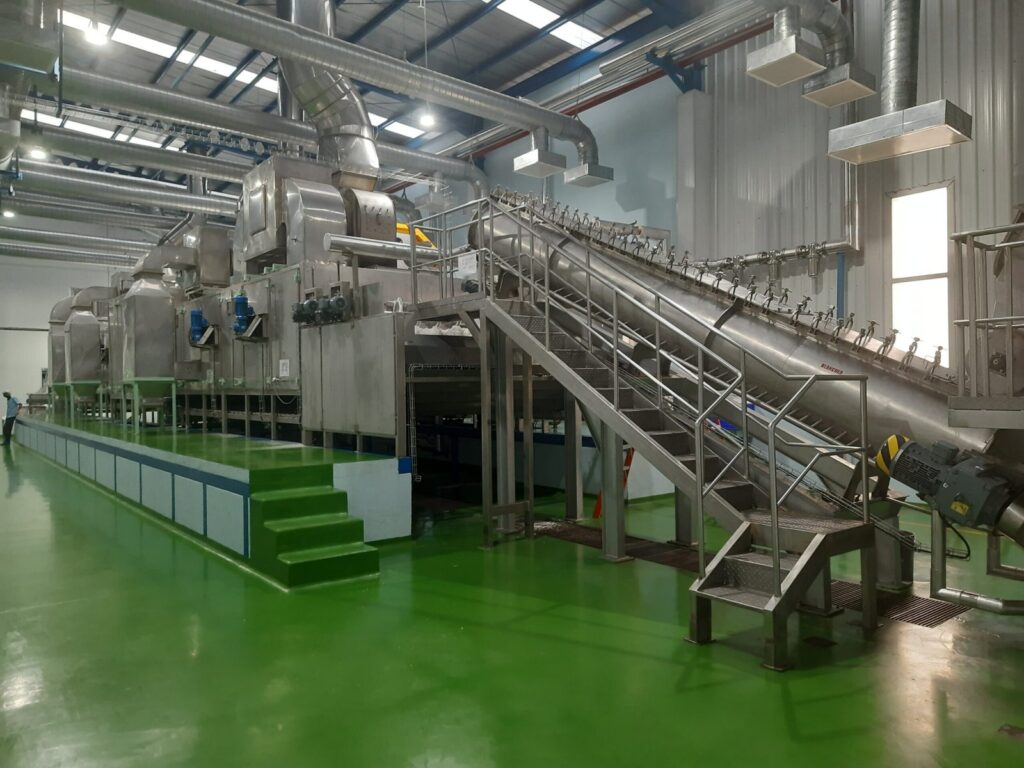
How do you commission a belt dryer plant? In five gated stages: mechanical completion checks, a cold run, a hot run without product, a staged load run, and a formal performance test against the contract design basis. Each stage has its own sign-off, so faults are found while they are cheap to fix. This guide is for project engineers, plant managers and investors commissioning band, belt or mesh belt dryer lines.
Moisture figures are on a wet basis. “Capacity” means dried product output, as GTI states band dryer capacity.
Why are buyers now specifying commissioning and testing as a deliverable?
Because public and lender-funded buyers increasingly buy a working plant, not a machine. A July 2026 tender under Maharashtra’s World Bank-funded SMART project asked bidders for the “Supply, Installation, Commissioning and Testing” of a 1 TPH semi-automatic onion and chilli dehydration unit. Commissioning and testing were part of the contract scope, not an extra.
The request for bids (RFB 2026_DOAWB_1314080, dated 3 July 2026) was issued by a farmer producer company in Gondia district (SMART project tender document). The notice does not say whether “1 TPH” means fresh feed or dried output, which is exactly what a commissioning plan must settle first.
What are the stages of belt dryer commissioning?
There are five stages: pre-commissioning (mechanical completion), cold commissioning, hot commissioning without product, load commissioning, and the performance test. Each has defined checks, a responsible party and a signed record. Do not move to the next stage with open safety items, and log every non-safety defect on a punch list with an owner and a date.
| Stage | Purpose | Key checks | Sign-off record |
|---|---|---|---|
| 1. Pre-commissioning | Confirm the plant is built as designed | Belt or mesh tension and tracking, chain lubrication, fan rotation, duct joints and inspection doors sealed, insulation complete, instrument loop checks, emergency stops | Mechanical completion certificate and punch list |
| 2. Cold commissioning | Run moving parts with no heat and no product | Belt speed calibration against the drive setting, fan currents, damper positions, airflow per zone, interlocks (heater cannot start without proven airflow) | Cold run report and interlock test sheet |
| 3. Hot run, no product | Prove heating and temperature control | Heat-up rate, zone temperature stability, temperature spread across belt width, steam trap or burner tuning, thermal expansion at duct supports | Temperature mapping record |
| 4. Load commissioning | Bring product in gradually | Feed spreading and bed depth, residence time against belt speed, first moisture results, sticking at the feed zone, fines in the exhaust | Daily start-up log with settings and results |
| 5. Performance test | Prove the contract design basis | Steady-state capacity, product moisture, utility use, mass balance closure | Signed performance test report |
What should the cold run catch?
Faults that are dangerous or expensive once the dryer is hot: a fan running backwards (it still moves some air, so it is easy to miss), a belt drifting to one side, a door switch missing from the interlock chain, or a damper fitted wrongly. Record airflow and damper settings zone by zone as the baseline.
Why map temperature across the belt width?
Because uneven moisture across the width is the most common start-up complaint, and it usually starts with uneven air. Measure air temperature at several points across each zone before product goes in, and fix airflow before touching setpoints. The GTI guide to uneven moisture in band and mesh belt dryers covers the diagnostic steps.
How do you ramp up feed during load commissioning?
In steps, starting at a partial feed rate and increasing only when product moisture and bed behaviour are stable. Hold each step for at least one full residence time plus sampling. Record belt speed, bed depth, zone temperatures and exhaust conditions at every step, so the settings that work become the first recipe.
Watch the feed zone: wet pieces can stick to the belt before a dry surface forms, and uneven spreading leaves thin lanes that over-dry and thick lanes that stay wet. On multi-tier dryers, check each transfer point for spillage and build-up.
How should a belt dryer performance test be run?
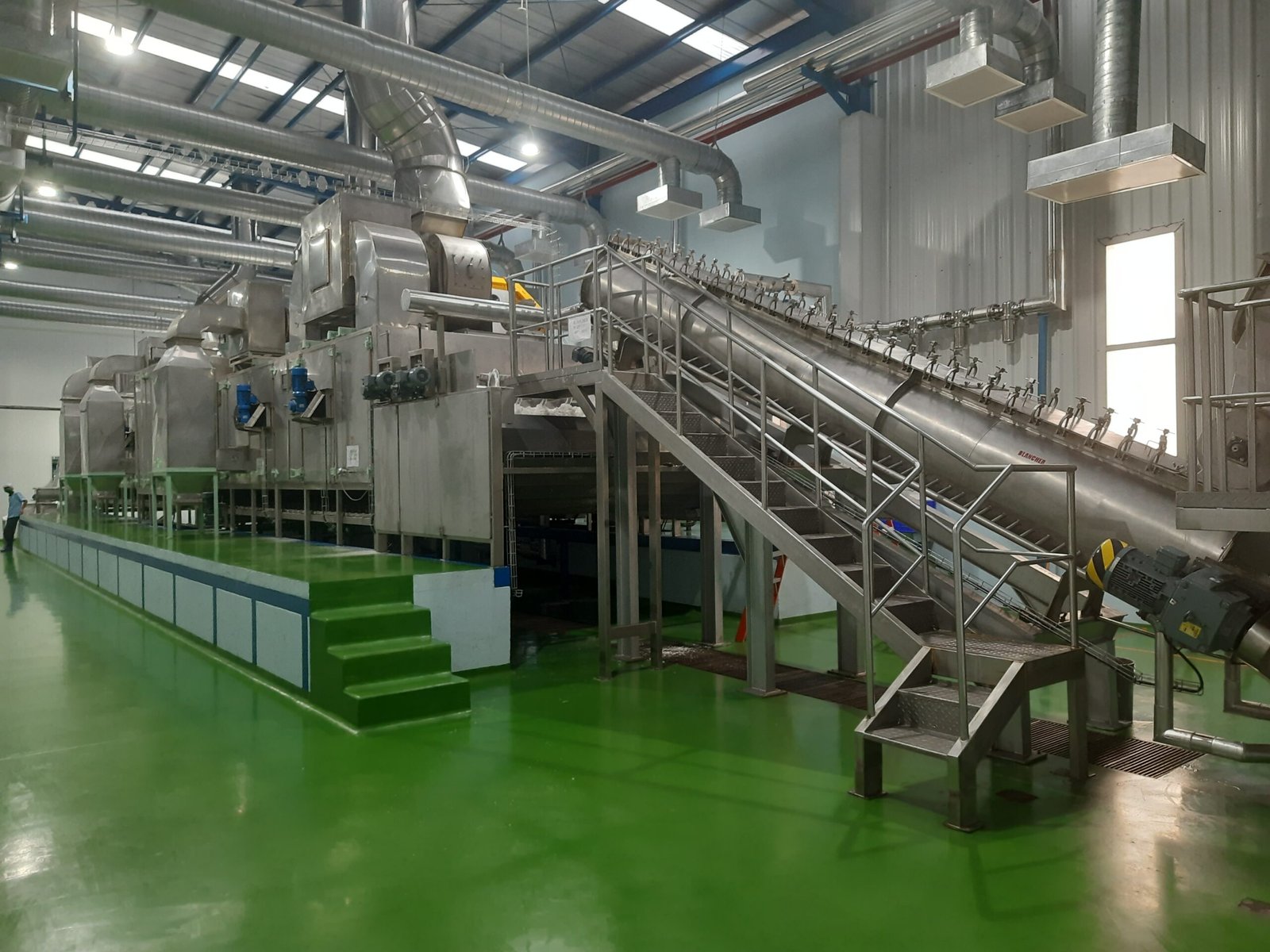
As a pre-agreed, steady-state test that measures capacity, product moisture and utilities at the same time, using a written procedure. Agree the test length, sampling plan, moisture method and acceptance tolerances in the contract. Then measure wet feed, dried product and utility use over the test period and check that the mass balance closes.
Published methods exist: the AIChE Equipment Testing Procedure for continuous direct-heat rotary dryers sets out material, moisture and energy balances, and the same logic carries over to belt dryers. A practical test plan covers:
- Design basis: feed material, feed moisture range, target product moisture, capacity definition (dried output in kg/h), ambient and utility conditions.
- Steady state: start the clock only once settings and exhaust conditions are stable.
- Sampling: product samples at several positions across the belt width and at fixed intervals. A single sample from the discharge chute hides lane-to-lane variation.
- Moisture method: name it (for example, a stated oven method, temperature and time) and use the same method for feed and product.
- Utilities: heat (steam, fuel or thermic fluid) and electricity, metered or calculated by a stated method.
- Closure: agree a mass balance tolerance (for example ±5%) and what happens if the client’s feed falls outside the design range.
Worked example: what should the test measure on a 200 kg/h line?
Illustrative calculation, not data from any plant. A band dryer is designed for 200 kg/h of dried vegetable pieces at 6% moisture, from fresh slices at 86% moisture.
| Quantity | Calculation | Result |
|---|---|---|
| Dry solids in product | 200 × (1 − 0.06) | 188 kg/h |
| Wet feed needed | 188 ÷ (1 − 0.86) | about 1,343 kg/h |
| Water evaporated | 1,343 − 200 | about 1,143 kg/h |
| Minimum latent heat | 1,143 kg/h × about 2,400 kJ/kg | about 2.7 GJ/h (about 760 kW) |
Two lessons follow. A 1-point error in feed moisture matters: at 87% instead of 86%, the same feed gives only about 186 kg/h of product, so feed moisture must be measured during the test. And real heat input will be well above the latent minimum because of exhaust, product and shell losses; the test should report measured heat per kg of water evaporated.
Which start-up problems are most common on belt and mesh belt dryers?
Most start-up problems trace back to air distribution, feed spreading or the exhaust system rather than the dryer’s rated heat. Uneven moisture, belt mistracking, product sticking at the feed end, condensation in exhaust ducts and fines carryover are the usual list. The table links each to its first check.
| Symptom | Likely cause | First check |
|---|---|---|
| Wet and dry lanes across the belt | Uneven feed spreading or airflow | Bed depth profile, temperature map across width |
| Belt drifts to one side | Roller alignment or uneven tension | Tracking rollers, tension at both sides |
| Product sticks in the first zone | Surface too wet, bed too deep | Pre-dewatering, spreading, first-zone air velocity |
| Water dripping from exhaust ducts | Exhaust below dew point in cold sections | Duct insulation, exhaust temperature and humidity |
| Fines in exhaust or on the roof | Air velocity too high through a fine bed | Fan speed, damper settings, cyclone or filter |
See also the GTI dew point troubleshooting guide and the band and mesh belt dryer maintenance checklist. For complete food lines, see fruit and vegetable dehydration plants on foodtechprojects.com.
Who is responsible for what during commissioning?
It depends on the contract model, so write it down before mobilisation. Under EPC or turnkey, the contractor usually leads every stage while the owner supplies feed, utilities and operators. Under supply-only or supply-plus-supervision, the owner’s team or erection contractor does the work and the supplier advises. Unclear splits cause most commissioning disputes.
Agree who supplies test feed, operators and laboratory support, who owns product made during commissioning, how many support days are included, and who signs each stage record. For a coconut-specific handover test, see the coconutprojects.com guide to coconut dryer performance tests.
What should the handover package contain?
Everything the owner needs to run, maintain and later prove the plant: signed stage records and the performance test report, as-built drawings and P&ID, control documentation with the final PLC program backup, operating and maintenance manuals, the proven recipe sheet, a spares list and training records. Close the punch list or agree dates for open items.
Frequently asked questions
Long enough at steady state to cover several residence times and a full sampling plan, as agreed in the contract. Start the test clock only after settings and exhaust conditions have stabilised, and measure feed, product and utilities over the same period.
It must be stated in the contract. GTI states band dryer capacity as dried product output. A 1-point change in feed moisture changes the product rate, so feed moisture must be measured during the test.
Uneven moisture across the belt width. It usually comes from uneven feed spreading or uneven airflow, so map bed depth and air temperature across the width before changing temperature setpoints.
Usually the owner, under every contract model. The contract should state how much test feed is needed, who provides operators and laboratory support, and who owns the product made during commissioning.
About Genex Tech Industries LLP (GTI Group)
Genex Tech Industries LLP (GTI Group) designs and manufactures industrial dryers, including the band dryers and mesh belt dryers described on gtidryers.com. Its published capabilities include process design, plant layout and engineering, PLC/SCADA automation, installation, commissioning and operator training. On this site, see our belt dryer page and the guide on how to specify a belt dryer for food processing. The head office is at 10C Middleton Row, Kolkata 700071, India.
Sources and authorship
- Hon. Balasaheb Thackeray Agribusiness and Rural Transformation (SMART) Project, Request for Bids 2026_DOAWB_1314080, “Supply, Installation, Commissioning and Testing of 1 TPH Semi-Automatic Onion/Chilly Dehydration Unit”, 3 July 2026.
- AIChE Equipment Testing Procedures Committee, “Continuous Direct-Heat Rotary Dryers: A Guide to Performance Evaluation”, 3rd edition, Wiley/AIChE, 2005.
- Published band dryer, mesh belt dryer and turnkey drying pages of Genex Tech Industries LLP (GTI Group).
The worked example is an illustrative calculation from stated assumptions, not a measurement from any plant. This article was prepared by the editorial team of Genex Tech Industries LLP (GTI Group) with AI editorial assistance. It has not been reviewed by a named engineer, and no individual is cited as having approved the technical content.
Next step
Planning the commissioning of a new belt dryer line, or a performance test on an existing one? Email mktg@gtidryers.com or use the contact page. Send your product, feed rate and feed moisture, target product moisture, heat source and utilities, and the installation location.